Showing posts with label randomized trials. Show all posts

Tuesday, September 27, 2022

Only One-Third of a Sample of RCTs Had Made Protocols Publicly Available, New Report Finds

Earlier this year, a study in PloS Medicine found that nearly one-third (30%) of a sample of randomized controlled trials (RCTs) had been discontinued prematurely, a number that had not improved over the previous decade. Furthermore, for every 10% increase in adherence to SPIRIT protocol reporting guidelines, RCTs were 29% less likely to go unpublished (OR: 0.71; 95% confidence interval: from 0.55 to 0.92), and only about 1 in every 5 unpublished trials had been registered.

Now, in this month's issue of Journal of Clinical Epidemiology, Schönenberger and colleagues have released a study of the availability of RCT protocols from a sample of published works.

Public availability of study protocols, the authors argue, improves research quality by promoting thoughtfulness in methodological design, reducing selective outcomes reporting or "cherry-picking," and reducing the misreporting of results while promoting ethical compliance. This is especially the case when trial protocols are made available before the publication of study results. 

From a random sample of RCTs approved by ethics committees in Switzerland, Germany, Canada, and the United Kingdom in 2012, the authors examined the proportion of studies that had publicly available protocols and the nature of how the protocols were cited and disseminated. Of the resulting 326 RCTs, 118 (36.2%) had publicly available protocols. Of the protocols, nearly half (47.5%) were available as standalone peer-reviewed publications while 40.7% were available as supplementary material with the published results. A smaller proportion (10.2%) of protocols were available on a trial registry. 

Studies with a sample size of >500 or that were investigator- (non-industry)-sponsored were more likely to have publicly available protocols. The nature of the intervention (drug versus non-drug) did not appear to affect protocol availability, nor did whether the trial was conducted in a multicenter or single-center setting. The majority (91.8%) of protocols were made available after the enrollment of the first patient, and just 2.7% were made available after publication of trial results. Protocols were commonly published shortly before the trial results, at a median of 90% of the time between the start of the trial and its publication.

As this sample comprised only RCTs published in 2012 and by relatively high-income countries, it is unclear whether public protocol availability has improved over time or may be different in other global regions. However, the authors argue, these numbers lend credence to the need for efforts to improve the public availability of RCT protocols, such as through trial registries or requirements by publishing or funding bodies.

Schönenberger, C.M., Griessbach, A., Heravi, A.T., et al. (2022). A meta-research study of randomized controlled trials found infrequent and delayed availability of protocols. J Clin Epidemiol 149:45-52. Manuscript available at publisher's website here


Wednesday, September 21, 2022

Standardized Mean Difference Estimates Can Vary Widely Depending on the Methods Used, New Review Finds

In meta-analyses of outcomes that utilize multiple scales of measurement, a standardized mean difference (SMD) may be used. Randomized controlled trials may also use SMDs to help interpret the effect size for readers. Most commonly, the SMD reports the effect size with Cohen's d, a metric of how many standard deviations are contained in the mean difference within or between groups (e.g., an intervention caused the outcome to increase or decrease by x number of standard deviations, or the two groups were x number of standard deviations different from one another with regards to the outcome). This is typically done by dividing the difference between groups, or from pretest to posttest in a single group, by some form of standard deviation (e.g., pooled standard deviation at baseline, posttest, or the standard deviation of change scores). Cohen's d is often utilized because a general rule of interpretation has been suggested: 0.2 is a small effect, 0.5 is a medium-sized effect, and 0.8 is large.

However, there are multiple ways to approach the calculation of SMDs, and these may result in varying interpretations of the size of the effect. To further investigate this, Luo and colleagues recently published a review of 161 articles using SMDs and the way they can be calculated. Of the 161 randomized controlled trials published since 2000 and reporting outcomes with some form of SMD, the authors calculated potential between-group SMDs using reported data and up to seven different methodological approaches.

Some studies reported more than one type of SMD, meaning that 171 total SMD approaches were reported across the 161 studies. Of these, 34 (19.9%) did not describe the chosen method at all, 84 (49.1%) reported but in insufficient detail, and 53 (31%) reported the approach in sufficient detail. The confidence interval was only reported for 52 (30.4%) of SMDs. Of the 161 individual articles, the rule for interpretation was clearly stated in only 28 (17.4%). 

The most common method of calculating SMD was using a standard deviation of baseline scores, seen in 70 (40.9%) of studies. Meanwhile, 30 (17.5%) used posttest standard deviations and 43 (25.1%) used the standard deviation of change scores.

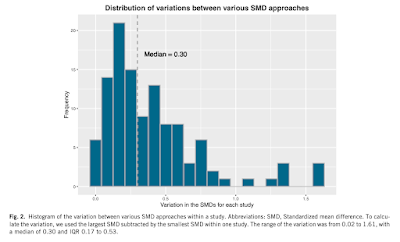
Figure displaying the variability of SMD estimates across 161 included studies. Click to enlarge.

Of all the potential ways to calculate SMD, the median article varied by 0.3 - which could potentially be the difference between a "small" and "moderate" or "between a "moderate" and "large effect size for Cohen's d using Cohen's suggested rule of thumbThe studies with the largest variation tended to have smaller sample sizes and greater reported effect sizes.

This work raises an important point, which is that while no one method for the calculation of SMDs is considered superior to another, if calculation approaches are not prespecified by researchers, different methods could be tried until the most impressive effect size is reached. To help prevent these issues, the authors suggest prespecifying the analytical approach and reporting SMDs together with raw mean differences and standard deviations to further aid interpretation and provide context. 

Luo, Y., Funada, S., Yoshida, K., et al. (2022). Large variation existed in standardized mean difference estimates using different calculation methods in clinical trials. J Clin Epidemiol 149: 89-97. Manuscript available at the publisher's website here.


Wednesday, May 18, 2022

New Study of Randomized Trial Protocols Highlights Prevalence of Early Discontinuation, Importance of Reporting Adherence

Registration of clinical trials was first introduced as a way to combat publication bias and avoid the duplication of efforts in medical research. Since then, the registration of clinical trials has been deemed a requirement of publication by the International Committee of Journal Editors (ICJE) and various federal laws. However, the mere registration of a clinical trial does not guarantee its ultimate completion, nor publication.

In a new article published last month in PLoS Medicine, Speich and colleagues set out to better understand the prevalence and impact of non-registration, early trial discontinuation, and non-publication within the current landscape of medical research.

An update of previous findings published in 2014, the study examined 360 protocols for randomized controlled trials (RCTs) approved by Research Ethics Committees (RECs) based in Switzerland, the United Kingdom, Germany, and Canada. Of these, 326 were eligible for further analysis. The team collected data on whether the trials had been registered, whether sample sizes were planned and achieved, and whether study results were available or published. The team also assessed each of the RCTs for protocol reporting quality based on the Standard Protocol Items: Recommendations for Intervention Trials (SPIRIT) guidelines. 

Overall, the included RCTs had a median planned sample size of 250 participants and met a median of 69% of SPIRIT guidelines. Just over half (55%) were sponsored by industry. The large majority (94%) were registered, though 10% were registered retrospectively. About half (53%) reported results in a registry, whereas most (79%) had published results in a peer-reviewed journal. However, adherence to reporting guidelines did not appear to the rate of trial discontinuation.

About one-third (30%) of RCTs had been prematurely discontinued, which indicated no change in this regard since the previous investigation of RCT protocols approved between 2000-2003 (28%). Most commonly, trials in the current investigation were discontinued due to preventable reasons such as poor recruitment (37%), organizational/strategic issues (6%), and limited resources (1%). A smaller proportion were discontinued due to preventable reasons such as futility (16%), harm (6%), benefit (3%), or external evidence (3%).

For every 10% increase in adherence to SPIRIT protocol reporting guidelines, RCTs were 29% less likely to go unpublished (OR: 0.71; 95% confidence interval: from 0.55 to 0.92), and only about 1 in every 5 unpublished trials had been registered.

The authors suggest that these findings implicate the need for investigators to report results of trials in registries as well as in peer-reviewed publications. Furthermore, future research may assess the utility of feasibility or pilot studies in reducing the rate of trial discontinuation due to recruitment issues. Journals can require trial registration as a requirement to publish. 

Speich, B., Gryaznov, D., Busse, J.W., lohner, S., Klatte, K., Heravi, A.T., ... & Briel, M. (2022). Nonregistration, discontinuation, and nonpublication of randomized trials: A repeated research meta-analysis. PLoS Medicine 19(4), e1003980. https://doi.org/10.1371/journal.pmed.1003980. Manuscript available at the publisher's website here.


Monday, September 13, 2021

Re-analysis of a systematic review on injury prevention demonstrates that methods do really matter

How much of a difference can methodological decisions make? Quite a bit, argues a new paper published in the Journal of Clinical Epidemiology. A re-analysis of a 2018 meta-analysis on the role of the Nordic hamstring curl (NHE) on injury prevention, the study outlined and then executed several methodological changes within the context of an updated search and found that the resulting magnitude of effect - and strength of recommendations using GRADE - were not quite as dazzling as the original analysis.

Impellizzeri and colleagues noted several suggested changes to the 2018 paper, including:

  • limiting the meta-analysis to higher-level evidence (randomized controlled trials) when available,
  • clarifying the interventions used in the included studies and being cognizant of the effect of co-interventions (for instance, when NHE was used alone versus in combination with other exercises as part of an injury reduction program),
  • being careful not to "double-dip" on events (i.e., injuries) that recur in the same individual when presenting the data as a risk ratio
  • discussing the impact of between-study heterogeneity when discussing the certainty of resulting estimates,
  • presenting the lower- and upper-bounds of 95% confidence intervals for estimates of effect in addition to the point estimates, and
  • taking the limitations of the literature and other important considerations into account when formulating final summaries or recommendations (for instance, using the GRADE framework)
The authors ran an updated systematic search but excluded non-randomized controlled trials or studies that incorporated other exercises with the NHE in the intervention group. Risk of bias was assessed using the Cochrane tool for randomized studies. The overall certainty of evidence as assessed using GRADE was rated "low," although given that concerns regarding risk of bias, inconsistency, and imprecision were noted, the certainty may range to "very low" following the standard GRADE framework. The forest plot of the updated analysis can be seen below.


The results of the updated analysis show that rather than reduce the risk of hamstring injury by 50%, the range of possible effects was too large to draw a conclusion on the effectiveness of this intervention, and only a conditional recommendation can be warranted.

Impellizzeri, F.M., McCall, A., and van Smeden, M. (2021). Why methods matter in a meta-analysis: A reappraisal showed inconclusive injury preventive effect of Nordic hamstring exercise. J Clin Epidemiol, in-press.

The manuscript is available at the publisher's site here.


Wednesday, April 21, 2021

In Studies of Patients at High Risk of Death, More Explicit Reporting of Functional Outcomes is Needed

Randomized controlled trials examining the effects of an intervention in patients with a high risk of death will often also include functional outcomes - such as quality of life, cognition, or physical disability. However, the death of patients before these outcomes can be assessed (also known as "truncation due to death") can confound the results of a "survivors-only" analysis, especially if mortality rates are higher in certain groups than others. 

A new methodology review of studies published within 5 high-impact general medical journals from 2014 to 2019 provides insight into this phenomenon and suggestions for improving how functional outcomes are handled. To be eligible for the review, a study needed to be a randomized controlled trial (RCT) with a mortality rate of at least 10% in one arm and to report at least one functional outcome in addition to mortality. The authors recorded the outcomes analyzed, the type of statistical analyses used, and the sample population of each of the 434 included studies. For most (351, or 79%) of these, function was a secondary outcome, while it was a primary outcome for 91 (21%) of them.

Only one-quarter (25%) of the functional outcomes within the studies that examined them as secondary outcomes used an approach that included all randomized patients (intention-to-treat); for the studies for which functional outcomes were the primary outcomes analyzed, this proportion was 60%.


The authors provide suggestions for best ways to handle and report data in these studies:
  • In the methods rather than only in tables or supplementary material, explicitly state the sample population from which the functional outcomes were drawn, whether it's survivors-only or another type of analysis.
  • If a survivors-only analysis is used, the authors should report the baseline characteristics between the groups analyzed and transparently discuss this as a limitation within the discussion section.
  • If all randomized participants are analyzed regardless of mortality, authors should report the assumptions upon which these analyses are based; for instance, if death is one outcome ranked among others in a worst-rank analysis, the justification for the ranking of outcomes should be discussed in the methods, and the implications of these decisions included in the discussion section. 
Colantuoni E, Li X, Hashem MD et al. (2021). A structured methodology review showed analyses of functional outcomes are frequently limited to "survivors only" in trials enrolling patients at high risk of death. J Clin Epidemiol (e-pub ahead of print).

Manuscript available here.

Friday, April 2, 2021

New Review of Pragmatic Trials Reveals Insights, Identifies Gaps

As opposed to an "explanatory" or "mechanistic" randomized controlled trial (RCT), which seeks to examine the effect of an intervention under tightly controlled circumstances, "pragmatic" or "naturalistic" trials study interventions and their outcomes when used in more real-world, generalizable settings. One example of such a study might include the use of registry data to examine interventions and outcomes as they occur in the "real world" of patient care. However, there are currently few standards for identifying, reporting, and discussing the results of such "pragmatic RCTs." A new paper by Nicholls and colleagues aims to provide an overview of the current landscape of this methodological genre.

The authors searched for and synthesized 4,337 trials using keywords such as "pragmatic," "real world," "registry based," and "comparative effectiveness" to better map an understanding of how pragmatic trials are presented in the RCT literature. Overall, only about 22% (964) of these trials were identified as "pragmatic" RCTs in the title, abstract, or full text; about half of these (55%) used this term in the title or abstract, while the remaining 45% described the work as a pragmatic trial only in the full text. 

About 78.1% (3,368) of the trials indicated that they were registered. However, only about 6% were indexed in PubMed as a pragmatic trial, and only 0.5% were labeled with the MeSH topic of Pragmatic Clinical Trial. The target enrollment of pragmatic trials was a median of 440 participants within an interquartile range (IQR) of 244 to 1,200; the actual achieved accrual was 414 (IQR: 216 - 1,147). The largest trial included 933,789 participants; the smallest enrolled 60.

Overall, pragmatic trials were more likely to be centered in North America and Europe and to be funded by non-industry sources. Behavioral, rather than drug or device-based, interventions were most common in these trials. Not infrequently, the trials were mislabeled or contained erroneous data in their registration information. The fact that only about half of the sample were clearly labeled as "pragmatic" may mean that these trials may go undetected with less sensitive search mechanisms than the authors used.

Authors of pragmatic trials can improve the quality of the field by clearly labelling their work as such and by registering their trials and ensuring that registered data are accurate and up-to-date. The authors also suggest that taking a broader view of what constitutes a "pragmatic RCT" also generates questions regarding proper ethical standards when research is conducted on a large scale with multiple lines of responsibility. Finally, the mechanisms used to obtain consent in these trials should be further examined in light of the finding that many pragmatic trials fail to achieve goals set for participant enrollment.

Manuscript available from publisher's web site here. 

Nicholls SG, Carroll K, Hey SP, et al. (2021). A review of pragmatic trials found a high degree of diversity in design and scope, deficiencies in reporting and trial registry data, and poor indexing. J Clin Epidemiol (ahead of print). 


Monday, March 15, 2021

A Blinding Success?: The Debate over Reporting the Success of Blinding

While the use of blinding is a hallmark of placebo-controlled trials, whether the blinding was successful - i.e., whether or not participants were able to figure out the treatment condition to which they have been assigned - isn't always tested, nor are the results of these tests always reported. The measurement of the success of blinding in trials is controversial and not uniformly used, and the item has been dropped from subsequent versions of the CONSORT reporting items for trials. According to a recent discussion of the pros and cons to measuring the success of blinding, only between 2-24% of trials perform or report these types of tests.

As Webster and colleagues explain, the benefits to measuring the success of blinding are as follows:

  • the success (or failure) of blinding in a placebo-controlled trial can introduce a source of bias that affects the results. 
  • while the effect of blinding itself may be small, these small effects could still result in changes to policy or practice
  • there are documented instances in which the failure to properly blind (for instance, providing participants with a sour-tasting Vitamin C condition versus a sweet lactose "placebo") led to an observed effect (for instance, on preventing or treating the common cold) whereas there was no effect in the subgroup of participants who were successfully blinded.
Reasons commonly given against the testing of successful blinding include the following:
  • At times, a break in blinding can lead to conclusions in the opposite direction. For instance, physicians who are unblinded may assume that the patients with better outcomes received a drug widely supposed to be "superior," when in fact, the opposite occurred.
  • In some cases, a treatment with dramatically superior results can result in unblinding, even when the treatment conditions were identical - but that doesn't necessarily mean the blinding was a failure or could have been prevented, given the dramatic differences in outcomes.
  • If the measurement of blinding is performed at the wrong time - such as before the completion of the trial - participants may become suspicious and this in itself could potentially confound treatment effects.


Webster RK, Bishop F, Collins GS, et al. (2021). Measuring the success of blinding in placebo-controlled trials: Should we be so quick to dismiss it? J Clin Epidemiol, pre-print.

Manuscript available from publisher's website here.