Showing posts with label meta-analysis. Show all posts

Sunday, March 24, 2024

Three's a Crowd: How to Deal with More than Two Arms in a Meta-Analysis

It is not uncommon to come across the following scenario: when conducting a meta-analysis between two arms (e.g., an active therapy vs. a placebo), the meta-analyst includes a study that actually included two active arms (e.g., two different doses of the same experimental drug vs. placebo, two different routes of administration, etc.) Let's say that both of these arms were relevant to the clinical question. How should meta-analysis be undertaken in this case? A new tutorial article published in Cochrane Evidence Synthesis and Methods gives a primer on how to approach this common conundrum. 

Including the study twice in the forest plot – for instance, with one dose versus placebo and the other versus the same placebo group – is statistically problematic. It leads to a "unit of analysis" error by essentially "double-counting" the participants in the control group and violating the assumption that every individual participant is only counted twice. (Aside: this is also a common error in meta-analyses combining multiple similar outcomes – e.g., including the handgrip strength of both the dominant and non-dominant hand in the same forest plot – and risks committing the same violation unless advanced multi-level statistical techniques are used to account for this). 

This leaves two basic options for including the data from more than two study arms into the same forest plot: combining interventions that are similar, and splitting the control group in half. For instance, if the three groups in question are as such (assuming a dichotomous outcome):

  • Experimental group A: 50 participants, 45 of whom had the event.
  • Experimental group B: 50 participants, 41 of whom had the event.
  • Control group: 50 participants, 22 of whom had the event.
These two experimental groups can either be combined (100 participants, 89 of whom had the event) and compared to the control group as-is, or they can be split out and compared (on separate lines of the forest plot) to half of the control group on each line:
  • Experimental group A (45 out of 50) versus control (11 out of 25)
  • Experimental group B (41 out of 50) versus control (11 out of 25).
Both approaches will yield very similar pooled results.

In the case of a continuous outcome, the same general approaches can be applied. However, if pooling two or more arms together, a pooled mean and SD will need to be calculated using the following equations from the Cochrane Handbook:

Reference: Axon, E., Dwan, K., & Richardson, R. (2023) Multiarm studies and how to handle them in a meta-analysis: A tutorial. Cochrane Evidence Synthesis and Methods. Available at publisher's website here.


Wednesday, September 21, 2022

Standardized Mean Difference Estimates Can Vary Widely Depending on the Methods Used, New Review Finds

In meta-analyses of outcomes that utilize multiple scales of measurement, a standardized mean difference (SMD) may be used. Randomized controlled trials may also use SMDs to help interpret the effect size for readers. Most commonly, the SMD reports the effect size with Cohen's d, a metric of how many standard deviations are contained in the mean difference within or between groups (e.g., an intervention caused the outcome to increase or decrease by x number of standard deviations, or the two groups were x number of standard deviations different from one another with regards to the outcome). This is typically done by dividing the difference between groups, or from pretest to posttest in a single group, by some form of standard deviation (e.g., pooled standard deviation at baseline, posttest, or the standard deviation of change scores). Cohen's d is often utilized because a general rule of interpretation has been suggested: 0.2 is a small effect, 0.5 is a medium-sized effect, and 0.8 is large.

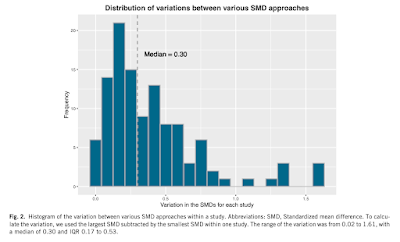
However, there are multiple ways to approach the calculation of SMDs, and these may result in varying interpretations of the size of the effect. To further investigate this, Luo and colleagues recently published a review of 161 articles using SMDs and the way they can be calculated. Of the 161 randomized controlled trials published since 2000 and reporting outcomes with some form of SMD, the authors calculated potential between-group SMDs using reported data and up to seven different methodological approaches.

Some studies reported more than one type of SMD, meaning that 171 total SMD approaches were reported across the 161 studies. Of these, 34 (19.9%) did not describe the chosen method at all, 84 (49.1%) reported but in insufficient detail, and 53 (31%) reported the approach in sufficient detail. The confidence interval was only reported for 52 (30.4%) of SMDs. Of the 161 individual articles, the rule for interpretation was clearly stated in only 28 (17.4%). 

The most common method of calculating SMD was using a standard deviation of baseline scores, seen in 70 (40.9%) of studies. Meanwhile, 30 (17.5%) used posttest standard deviations and 43 (25.1%) used the standard deviation of change scores.

Figure displaying the variability of SMD estimates across 161 included studies. Click to enlarge.

Of all the potential ways to calculate SMD, the median article varied by 0.3 - which could potentially be the difference between a "small" and "moderate" or "between a "moderate" and "large effect size for Cohen's d using Cohen's suggested rule of thumbThe studies with the largest variation tended to have smaller sample sizes and greater reported effect sizes.

This work raises an important point, which is that while no one method for the calculation of SMDs is considered superior to another, if calculation approaches are not prespecified by researchers, different methods could be tried until the most impressive effect size is reached. To help prevent these issues, the authors suggest prespecifying the analytical approach and reporting SMDs together with raw mean differences and standard deviations to further aid interpretation and provide context. 

Luo, Y., Funada, S., Yoshida, K., et al. (2022). Large variation existed in standardized mean difference estimates using different calculation methods in clinical trials. J Clin Epidemiol 149: 89-97. Manuscript available at the publisher's website here.


Monday, September 13, 2021

Re-analysis of a systematic review on injury prevention demonstrates that methods do really matter

How much of a difference can methodological decisions make? Quite a bit, argues a new paper published in the Journal of Clinical Epidemiology. A re-analysis of a 2018 meta-analysis on the role of the Nordic hamstring curl (NHE) on injury prevention, the study outlined and then executed several methodological changes within the context of an updated search and found that the resulting magnitude of effect - and strength of recommendations using GRADE - were not quite as dazzling as the original analysis.

Impellizzeri and colleagues noted several suggested changes to the 2018 paper, including:

  • limiting the meta-analysis to higher-level evidence (randomized controlled trials) when available,
  • clarifying the interventions used in the included studies and being cognizant of the effect of co-interventions (for instance, when NHE was used alone versus in combination with other exercises as part of an injury reduction program),
  • being careful not to "double-dip" on events (i.e., injuries) that recur in the same individual when presenting the data as a risk ratio
  • discussing the impact of between-study heterogeneity when discussing the certainty of resulting estimates,
  • presenting the lower- and upper-bounds of 95% confidence intervals for estimates of effect in addition to the point estimates, and
  • taking the limitations of the literature and other important considerations into account when formulating final summaries or recommendations (for instance, using the GRADE framework)
The authors ran an updated systematic search but excluded non-randomized controlled trials or studies that incorporated other exercises with the NHE in the intervention group. Risk of bias was assessed using the Cochrane tool for randomized studies. The overall certainty of evidence as assessed using GRADE was rated "low," although given that concerns regarding risk of bias, inconsistency, and imprecision were noted, the certainty may range to "very low" following the standard GRADE framework. The forest plot of the updated analysis can be seen below.


The results of the updated analysis show that rather than reduce the risk of hamstring injury by 50%, the range of possible effects was too large to draw a conclusion on the effectiveness of this intervention, and only a conditional recommendation can be warranted.

Impellizzeri, F.M., McCall, A., and van Smeden, M. (2021). Why methods matter in a meta-analysis: A reappraisal showed inconclusive injury preventive effect of Nordic hamstring exercise. J Clin Epidemiol, in-press.

The manuscript is available at the publisher's site here.


Wednesday, August 4, 2021

Correction to guidance for assessing imprecision with continuous outcomes

Systematic review and guideline developers take note: the authors of the 2011 guidance on assessing imprecision within the GRADE framework have recently issued a correction related to the assessment of information size when evaluating a continuous outcome.


Whereas the article stated originally that a sample size of approximately 400 (200 per group) would be required to detect an effect size of 0.2 standard deviations assuming an alpha of 0.05 and a power of 0.8, the correct number is actually 800 (400 per group). 

The full corrigendum can be read here. 

Thursday, July 29, 2021

New GRADE guidance on assessing imprecision in a network meta-analysis

Imprecision is one of the major domains of the GRADE framework and is used to assess whether to rate down the certainty of evidence related to an outcome of interest. In a traditional ("pairwise") meta-analysis which compares two intervention groups, exposures, or tests against one another, two considerations are made: the confidence interval around the absolute estimate of effect, and the optimal information size (OIS). If the bounds of the confidence interval cross a threshold for a meaningful effect, and/or if optimal information size given the sample size in the meta-analysis is not met, then one should consider rating down for imprecision.

In the context of small sample sizes, confidence intervals around an effect may be fragile - meaning they could be changed substantially with additional information. Therefore, the consideration of OIS along with the bounds of the confidence interval helps address this concern when rating the certainty of evidence to develop a clinical recommendation. This is typically done by assessing whether the sample size of the meta-analysis meets that determined by a traditional power analysis for a given effect size.

However, in a network meta-analysis, both direct and indirect comparisons are made across various interventions or tests. Thus, especially if the inclusion of indirect comparisons changes the overall estimate of effect, considering only the sample size involved in the direct comparisons would be misleading. 


A new GRADE guidance paper lays out how to assess imprecision in the context of a network meta-analysis:

  • If the 95% confidence interval crosses a decision-making threshold, rate down for imprecision. Thresholds should be ideally set a priori. It may be considered to rate down by two or even three levels depending on the degree of imprecision and the resulting communication of the certainty of evidence. For example, if imprecision is the only concern for an outcome, rating down by two instead of one level would be the difference between saying that a certain intervention or test "likely" or "probably" increases or decreases a given outcome, versus whether it simply "may" have this effect.
  • If the 95% confidence interval does not cross a decision-making threshold, consider whether the effect size may be inflated. If a point estimate is far away enough from a threshold, even a relatively wide CI may not cross it. Further, relatively large effect sizes from smaller pools of evidence can be reduced with future research. 
    • In the case of a large effect size, consider whether OIS is met. If the number of patients contributing to a NMA does not meet this number, consider rating down by one, two, or three levels depending on the severity of the width of the CI. 
    • If the upper-limit of a confidence interval using relative risk is 3 or more times higher than the lower-limit, OIS has likely not been met. Similarly, upper-to-lower-limit comparisons of odds ratios exceeding 2.5 have likely not met OIS.
  • Alternatively, when the effect size is both modest, plausible, and does not cross a threshold, one likely does not need to rate down for imprecision. 
  • Avoid "double dinging" for imprecision if this limitation has already been addressed by rating down elsewhere.

Brignardello-Peterson R, Guyatt GH, Mustafa RA, et al. (2021). GRADE guidelines 33. Addressing imprecision in a network meta-analysis. J Clin Epidemiol (in-press). 

Manuscript available at the publisher's website here.


Tuesday, May 4, 2021

Restricting Systematic Search to English-only is a Viable Shortcut in Most, but Perhaps Not All Topics in Medicine

In the limitations sections of systematic reviews on any topic, it is not uncommon for the authors to discuss how language limitations within their search may have restricted the breadth of evidence presented. For instance, if the reviewers speak only English, the review is likely limited to publications and journals in that language. But how much of a difference does such a limitation make in terms of the overall conclusions of a systematic review? According to a new paper in the Journal of Clinical Epidemiology, probably not much - but it may depend on the specific topic of medicine under investigation.

While other methods reviews have previously examined this question, Dobrescu and colleagues extended the range of topics to methods reviews that included systematic reviews within the realm of complementary and alternative medicine, yielding four reviews previously unexamined by prior studies. Specifically, the authors looked for methods reviews comparing the restriction of literature searches to English-only versus unrestricted searches and whose primary outcomes compared differences in treatment effect estimates, certainty of evidence ratings, or conclusions based on the language restrictions enforced. 

The search yielded eight studies investigating the impact of language restrictions in anywhere from 9 to 147 systematic reviews in medicine. Overall, the exclusion of non-English articles had a greater impact on estimates of treatment effects and the statistical significance of findings in reviews of complementary and alternative medicine versus conventional medicine topics. Most commonly, the exclusion of non-English studies led to a loss of statistical significance in these topic areas.

Overall, the methods studies examined found that the exclusion of non-English studies of conventional medicine topics led to small to moderate changes in the estimate of effect; however, exclusion of non-English studies shrank the observed effect size in complementary and alternative medicine topics by 63 percent. Two studies examined whether language restricted influenced authors' overall conclusions, generally finding no effect.

The figure above shows the frequency of languages of the excluded reviews examined.

The authors conclude that when it comes to systematic reviews of conventional medicine topics, their findings are in line with those of previous methods studies which demonstrate little to no effect of language restrictions and suggest that restricting a search to English-only should not greatly impact the findings or conclusions of a review. However, the effect appears greater in the realm of complementary and alternative medicine, perhaps due to the greater proportion of non-English studies published in this field. Thus, systematic reviewers attempting to synthesize the evidence on an alternative medicine topic should be cognizant of their choices regarding language restriction and the potential implications they may have on their ultimate findings.

Dobrescu A, Nussbaumer SB, Klerings I et al. (2021). Restricting evidence syntheses of interventions to English-language publications is a viable methodological shortcut for most medical topics: A systematic review: Excluding English-language publications a valid shortcut. J Clin Epidemiol, epub ahead of print.

Manuscript available from publisher's website here. 


Wednesday, March 3, 2021

Dealing with Zero-Events Studies in Meta-analysis: There's a Better Way than Throwing it Away!

When meta-analyzing data from studies examining the incidence of rare events - or those with a small sample size or short follow-up period, it is not uncommon to come across a study with 0 events of the outcome of interest. In fact, approximately one-third of a random sample of 500 Cochrane reviews contained at least one zero-events study.

Zero-events studies are typically categorized as single-arm (there are 0 events reported in just one group) or double-arm (there are 0 events reported in both groups). While some software automatically discard double-arm zero-events studies from a meta-analysis, this is not ideal because these data still add useful information in regards to the overall effect of an intervention. Ideally, meta-analyses could include a pooled event count that may be zero in one arm, both arms, or neither, with various single-arm and double-arm zero-events studies potentially contributing to this final effect. Thus, in a recently published article, Xu and colleagues propose a more detailed framework for approaching zero-events studies in the context of a meta-analysis. 

The authors describe six classifications as follows, with the degree of difficulty when meta-analyzing generally increasing from 1 to 6:

1) MA-SZ: meta-analysis contains zero-events only occurring in single arms, no double-arm-zero-events studies are included, and the total events count in neither arm is zero;

2) MA-MZ: meta-analysis contains zero-events occurring in both single and double arms, and the total events count in neither arm is zero;

3) MA-DZ: meta-analysis contains zero-events only occurring in double arms, and the total events count in neither arm is zero;

4) MA-CSZ: meta-analysis contains zero-events occurring in single arms, and no double-arm-zero-events studies are included, while the total events count in one of the arms is zero;

5) MA-CMZ: meta-analysis contains zero-events occurring in both single arm and double arms, while the total events count in one of the arms is zero;

6) MA-CDZ: meta-analysis only includes double-arm-zero-events studies, while the total events count in both arms are zero


The authors examined data from the Cochrane Database of Systematic Reviews (CDSR), including any review published between January 2003 - May 2018 and meta-analyzing at least two studies. Of the 61,090 reviews identified with binary outcomes, 21,288 (34.85%) contained at least one zero-events study. In a great majority (90.7%) of these, the total event count was greater than zero for both arms and the meta-analysis only included single-arm rather than double-arm zero-events studies. Second most common (6.21%) was the MA-CSZ, in which the total event count includes one arm with zero events, and the zero-events studies included are only single-arm. All others of the four remaining categories each made up less than 1.5% of the whole.
The authors propose that those looking to meta-analyze studies that include zero events first categorize their specific subtype, and then work through one of the suggested methods in the figure below. Finally, a sensitivity analysis should be used following an alternative method to determine the robustness of the results.


Xu C, Furuya-Kanamori L, Zorzela L, Lin L, and Vohra S. (2021). A proposed framework to guide evidence synthesis practice for meta-analysis with zero-events studies. J Clin Epidemiol, in-press.
Manuscript available from the publisher's website here