Showing posts with label Workshop. Show all posts

Wednesday, July 3, 2024

EF Scholar Success Story: Nirjhar Ruth Ghosh

 New publication alert!

Nirjhar Ruth Ghosh, who attended the winter 2022 Systematic Review workshop as an Evidence Foundation scholar, recently published the results of her hard work in The Journal of Nutrition! The project, "Evidence-Based Practice Competencies Among Nutrition Professionals and Students: A Systematic Review" was originally presented by Ghosh to her fellow attendees of the virtual workshop. The results of the systematic review are now able to be read in detail at this link. 

In an accompanying editorial lauding the publication, Francene M. Steinberg wrote that "Ghosh et al. have provided a foundation for further consideration of steps to advance interprofessional competencies in EBP to optimize clinical nutrition decision making and patient care outcomes. Improved clarity about core competencies, innovative EBP curriculum and pedagogic approaches, and more rigorous research evaluations of EBP application and outcomes are all necessary components of the path forward."


Congratulations, Ruth!

Interested in being our next scholar success story? Applications for scholarships to attend our fully virtual GRADE Guideline Development Workshop are now open (deadline: August 31). Learn more at https://evidencefoundation.org/scholarships


=

Monday, May 1, 2023

GRADE Guideline Development Workshop - now with INGUIDE!

We at the U.S. GRADE Network are excited to announce that, for the first time ever, we have partnered with INGUIDE, a credentialing system for guideline developers, to offer free access to their Level 1 online training to participants of our Guideline Development Workshop and Guideline Fundamentals for Panel Members and Organization Staff pre-workshop course. 

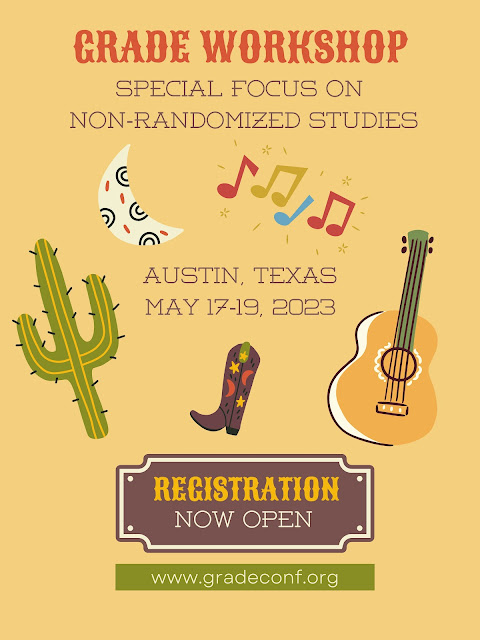
This announcement comes just in time for our next workshop, held in Austin, Texas May 17-19, for which there are still spots available at our workshop website.


The INGUIDE program, the result of a collaboration between the Guidelines International Network (G-I-N) and McMaster University, provides certification of individuals involved in guideline development on four successive levels, from a Guideline Panel Member to becoming a Guideline Development Credentialing Instructor themselves. 

To obtain access to the INGUIDE Level 1 course, simply register for and attend our 3-day GRADE guideline development workshop in addition to the pre-workshop course on Guideline Fundamentals for Panel Members and Organization Staff. This 3-hour pre-workshop course will cover all of the necessary information about the practical aspects of guideline development, including:
  • the importance of trustworthy guidelines
  • checklists for the development of guidelines
  • the structure and roles of a guideline panel
  • the process of grading evidence and formulating recommendations
The main 3-day workshop will cover important aspects of assessing risk of bias, rating the certainty of evidence, and considering other important factors when using GRADE to develop a guideline.

Our pre-workshop course combined with our main three-day in-person course will provide all of the training required for a breeze-through experience online. You will receive free access to the ~2-3 hour online course, comprising four modules, that you can complete at your convenience after the workshop. Upon completion, you will be officially certified as an INGUIDE Level 1 Guideline Panel Member.

Tuesday, April 11, 2023

Why We Can't Wait for Our Austin Workshop

The U.S. GRADE Network's 18th workshop is just five weeks away! With a focus on assessing certainty of evidence informed by non-randomized studies, this workshop will take place in Austin, Texas - the home of Austin City Limits, the famous Bat Bridge, and some next-level barbecue joints.

We asked some of the workshop facilitators about what they're looking forward to about the trip (besides the chance to talk about GRADE and evidence-based medicine for three days straight!) Here's what they said...


Limited space remains for the workshop. Learn more and register and www.gradeconf.org. 


Tuesday, January 17, 2023

2022 Recap and What's Next for the U.S. GRADE Network

Thanks to you, 2022 was one of our best years yet.

We were relieved to see you in person, our first time since 2020, at our spring workshop in Chicago last June! Then, we reconvened online for a virtual workshop in November. Overall, we hosted over 100 participants from around the world, stretching from Canada and Spain to Colombia and Sweden. 

Facilitators and participants at the spring 2022 GRADE guideline development workshop in Chicago, IL - the first in-person USGN workshop since March 2020.

We also launched our new two-day virtual Systematic Review workshop offering and welcomed another 48 learners, including a record 13 scholars from across the globe!

We published our takeaways from our early experiences moving our workshop online in response to the Covid-19 pandemic in BMJ Evidence-Based Medicine, which you can read about here.

Finally, we launched the USGN Webinar Series and will host regular free webinars on all things GRADE. For our inaugural session, we were joined by Drs. Gordon Guyatt and Reem Mustafa. You can watch the recording and subscribe to our new YouTube channel here. 


We look forward to seeing you at our 18th Guideline Development Workshop, in person in sunny Austin, Texas, May 17-19, 2023! The workshop will have a special focus on assessing the certainty of evidence informed by non-randomized studies.
Registration is now open.


Tuesday, October 18, 2022

U.S. GRADE Network Describes Experience Moving to All-Virtual Workshop Format

On March 4-6, 2020, the U.S. GRADE Network held an in-person workshop in Phoenix, Arizona, much like any of the 11 workshops to have come before it. Participants and facilitators enjoyed a taco buffet bar together at the first night's reception, sat together in small and large rooms to learn and collaborate, and mingled over coffee and pastry refreshments during breaks.

One week later, the World Health Organization announced that COVID-19 had reached pandemic proportions. 

Over that summer, the USGN took our workshops online, hosting three consecutive fully virtual workshops in October 2020, May 2021, and October 2021. While some changes were made (the addition of multiple, 45-60 minute breaks, for instance, to accommodate eating times in multiple time zones), much of what lay at the heart of a GRADE workshop remained: a three-day format  including plenary lectures from PICOs to recommendations, presentations by Evidence Foundation scholars, and small-group, hands-on experiential learning opportunities.

The USGN's shift to an all-virtual setting, and its challenges as well as opportunities for growth, are presented in a new paper by Siedler and colleagues published online in the BMJ Evidence-Based Medicine journal. Using routine feedback survey data collected both before and after the pandemic, the authors (all GRADE workshop facilitators) found that...

  • Perceived understanding of GRADE improved to the same extent in virtual and in-person formats,
  • At least half of attendees (54-62%) indicated that the virtual format was important for their ability to attend, and
  • Participants indicated a high degree of workshop satisfaction and perceived educational value. Similar results were observed for the level of knowledgeability of speakers, value of plenary sessions, and helpfulness of small-group sessions.

The major takeaway from the USGN's experience in an all-virtual format is that, based upon positive feedback and the ability to reach a global audience of learners, it will continue to offer learning opportunities in a virtual setting this year and beyond.

In fact, the next all-virtual workshop will take place November 30-December 2, 2022, and registration is now open at www.gradeconf.org.

Siedler MR, Murad MH, Morgan RL, et al. (2022). Proof of concept: All-virtual guideline development workshops using GRADE during the COVID-19 pandemic. BMJ Evidence-Based Medicine (online before print). Manuscript available from publisher's website here.


Wednesday, August 3, 2022

Spring 2022 Scholars Discuss Developments in Diagnostic and Environmental Health Evidence

The USGN's 16th GRADE Guideline Development Workshop, held in Chicago, was the first to be held in-person since March of 2020. In classic USGN style, participants enjoyed vibrant conversation, hours of learning, and delicious yogurt parfaits and strong coffee during morning breaks.

Two participants joined the fun and learning as part of the Evidence Foundation scholarship program, presenting to fellow attendees about their current projects related to evidence synthesis and guideline development. 

Spring 2022 Evidence Foundation scholars Kapeena Sivakumaran and Ibrahim El Mikati, center, pose for a photo between sessions in Chicago with the U.S. GRADE Network faculty (from left to right: Reem Mustafa, Philipp Dahm, Shahnaz Sultan, Yngve Falck-Ytter, Rebecca Morgan, and Hassan Murad).

Ibrahim El Mikati, a post-doctoral research fellow in the Outcomes and Implementation Research Unit at the University of Kansas Medical center, discussed his project helping to develop guidance for judging imprecision in diagnostic evidence. This approach will utilize thresholds for confidence intervals and will also introduce the concept of optimal information sizes for assessing imprecision in the context of diagnostic guidelines.

One thing that the GRADE workshop has helped me appreciate is transparency," said Ibrahim. "Having a transparent explanation of judgments provides users with trustworthy guidelines."

Kapeena Sivakumaran is currently leading two systematic reviews for Health Canada related to the impact of noise exposure and sleep disturbance on health outcomes. Challenges of these projects include a focus on short-term outcomes in the relevant literature as well as the need to incorporate multiple evidence streams, such as mechanistic data that can be interpreted in conjunction with observational evidence. 

“The workshop provided me with valuable insight into guideline development and using the GRADE approach to assess the evidence," said Kapeena. "One new thing I learned from the workshop was how automation and [artificial intelligence] can be integrated into the process of living systematic reviews to support guideline development.”

Note: applications for scholarships to attend our upcoming systematic review and guideline development workshops, held virtually, close August 12th and September 30th, 2022, respectively. See application details here.


Saturday, March 5, 2022

U.S. GRADE Network Holds Its First Two-Day Systematic Review Workshop

In response to popular demand, the U.S. GRADE Network recently expanded its half-day course on systematic reviews into a two-day virtual workshop. Taking place over February 1-2, 2022, the sessions comprised six total hours of instructional time and question-and-answer sessions with Network faculty in addition to three hours of hands-on activities in a small-group format. Large-group lectures ranged from developing a focused clinical question to conducting meta-analysis and evaluating the quality of systematic reviews. In hands-on sessions of ten participants each, attendees were introduced to a free online screening platform (Rayyan) and tried their hands at assessing risk of bias and conducting meta-analysis in RevMan, a free systematic review and meta-analysis software from Cochrane.

As part of the program, the Evidence Foundation welcomed three recipients of scholarships to attend the workshop free of charge. As part of their applications, the scholars described a current or proposed project for a systematic review. The three recipients, along with their projects, included:
• Bryden Giving, MAOT, OTR/L (Boston University): A traffic light of evidence for occupational therapy interventions supporting autistic children and youth
• Nirjhar Ruth Ghosh, MS (Texas A&M University): Evidence-based practice in the field of nutrition: A systematic review of knowledge, skills, attitudes, behaviors and teaching strategies
• Milton A. Romero-Robles (Universidad Nacional del Santa): Participation, involvement and main barriers in the inclusion of patients with non-communicable diseases in the development of clinical practice guidelines: A systematic review protocol


Be the first to hear about these and other trainings @USGRADEnet on twitter or at www.systematicreview.org.

Note: applications for scholarships to attend the upcoming GRADE Guideline Development Workshop held July 29-July, 2022, in Chicago, Illinois, close March 31. See application details here.


Monday, December 20, 2021

2021 Reflections Before a Big Year Ahead

 From all of us at the U.S. GRADE Network, thanks for making 2021 a year to remember.

  • We hosted our 14th and 15th workshops virtually - meaning we had the joy of talking GRADE with 95 attendees from many corners of the world, including Spain, Argentina, Pakistan, and Peru.
  • We co-published an international needs assessment of guideline-producing organizations in collaboration with the Guidelines International Network.
  • We announced our first ever two-day comprehensive systematic review workshop scheduled to be held virtually this coming February 1-2. Learn more and register here.
  • And we continue to look forward to hosting our 16th guideline development workshop, once again live and in person, from June 29-July 1, 2022, in Chicago, Illinois. Registration now open.

GRADE faculty take a moment to pose for a picture with some attendees of the fall 2021 virtual guideline development workshop.

Stay tuned for more.

To stay up-to-date on all future news, events, and research round-ups from us, make sure to follow us on Facebook, twitter, and LinkedIn.

Thanks again for an excellent year, and our best and brightest wishes for a brilliant 2022.


Thursday, November 11, 2021

Fall Scholars Dazzle at the 15th GRADE Guideline Development Workshop

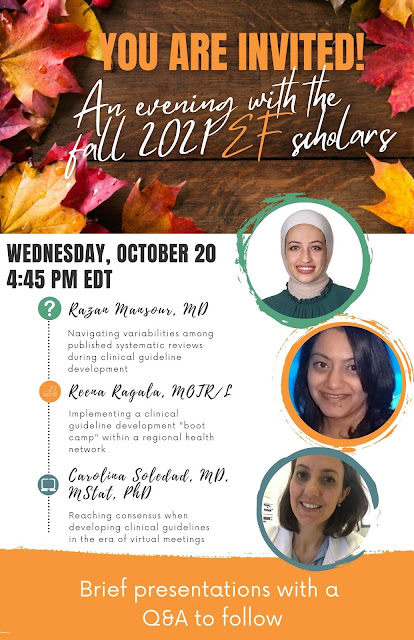
During the 15th GRADE Guideline Development Workshop held virtually last month, the Evidence Foundation had the pleasure of welcoming three new scholars with the opportunity to attend the workshop free of charge. As part of the scholarship, each recipient presented to the workshop attendees about their current or proposed project related to evidence-based medicine and reducing bias in healthcare.


Razan Mansour, MD, a postdoctoral research fellow at the University of Kansas Medical Center,  spoke about the challenges of navigating variabilities among published systematic reviews when developing clinical recommendations. Variability may emerge from differences between reviews regarding study inclusion criteria, risk of bias assessment, and the way data are presented. Most sources of variability, Dr. Mansour said, are difficult to explain, but a modified version of the A MeaSurement Tool to Assess systematic Reviews (AMSTAR) 2 tool can help identify common "red flags" and help to prioritize and identify the best systematic reviews off of which to base resulting clinical recommendations. Information from multiple higher-quality systematic reviews may be used, and data from individual studies may need to be extracted to paint a complete picture of the evidence.

Says Dr. Mansour, "Learning about how to rate the certainty of evidence about diagnosis was particularly helpful to me, as this is usually challenging. The subgroup discussions were perfect for one-to-one learning and applying your skills as you go through GDT."

Next, Reena Ragala, MOTR/L, spoke about her project as a Senior Evidence-Based Practice Analyst at the Medical University of South Carolina Value Institute. The Institute was established in 2012 to support MUSC's efforts to build the infrastructure to advance science and discovery through evidence-based practice. Starting in the spring/summer of 2022, Ragala will help lead guideline development "boot camps" though the Institute to train providers within rural health networks in the application of evidence-based guideline methodology. Through this process, Ragala hopes to empower rather than intimidate front-line staff and clinicians new to clinical guideline development.

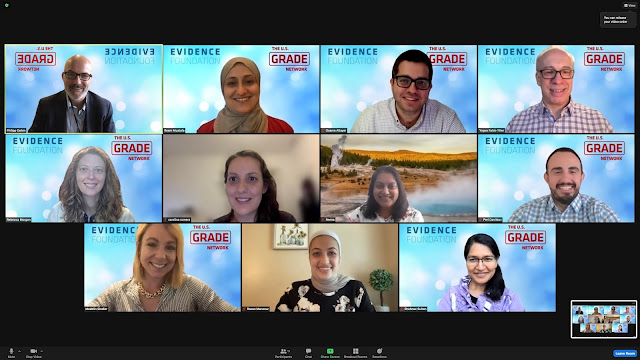
The fall 2021 Evidence Foundation scholars pose for a virtual group photo with U.S. GRADE Network faculty between workshop sessions. From top-left:  Philipp Dahm, Reem Mustafa, Osama Altayar, Yngve Falck-Ytter, Rebecca Morgan, Carolina Soledad, Reena Ragala, Perica Davitkov, Madelin Siedler, Razaan Mansour, and Shahnaz Sultan.

"When using GRADE for diagnostic tests or guideline development, judgements or recommendations are based on patient outcomes, said Ragala. "GRADE doesn’t just look at the strength/quality of the evidence, but incorporates the feasibility, accuracy, bias, and benefit/harm to the patient to ultimately make recommendations."

Carolina Soledad, MD, MStat, PhD, spoke about the unique opportunities, challenges, and solutions within an aspect of guideline development that has gained great relevance in recent years: reaching consensus within the context of virtual meetings. Dr. Soledad, a junior methodologist within the European Society of Anesthesia and Intensive Care (ESAIC) Guidelines Committee, discussed the fact that while in-person meetings have several strengths -  such as access to nonverbal cues such as body language and facial expression and shared context - virtual meetings also have unique benefits, such as cost savings and a reduced need to focus on logistics. In addition, they have become a necessity in the age of a global pandemic. To help address the unique questions surrounding virtual meetings - such as the optimal length and number of participants  - Dr. Soledad developed a 33-item survey of anesthesiologists and intensivists involved in guideline development. The findings will help formulate best practices for improving the level of communication, engagement, and effectiveness of future virtual meetings.

According to Dr. Soledad, "This workshop gave me a peek into GRADEpro GDT software, and it turned out to be easier to use than I've thought!"

If you are interested in learning more about GRADE and attending the workshop as a scholarship recipient, applications for our upcoming workshop in Chicago, Illinois, are now open. The deadline to apply is March 31, 2022. Details can be found here. 


Monday, November 16, 2020

Evidence Foundation Welcomes Four Scholars in First Virtual Workshop

In late October, the U.S. Grade Network held its thirteenth GRADE Guideline Development Workshop. Like any of the twelve workshops before it, there was much learning, discussion, and networking to be shared. However, unlike any workshop in the past, it was fully online.

Among the 45 attendees who participated in offices and living rooms from Brazil to Cyprus were four participants who attended the workshop free of charge as recipients of the Evidence Foundation scholarship. During a virtual Evening with the Fall 2020 Evidence Foundation Scholars, these four bright minds presented briefly on a proposal or current project designed to reduce bias in healthcare.

Dr. Stavros Antoniou, Chair of the European Association for Endoscopic Surgery Guidelines Subcommittee, discussed the tripartite Guideline Assessment Project (GAP) aimed at developing an extension of the AGREE II tool for surgical guidelines. In an exploratory analysis published earlier in 2018 (GAP I), Antoniou and colleagues assessed 67 surgical guidelines and reported that development of more than one guideline per year, the presence of a guideline committee, and the use of GRADE was associated with higher scores in AGREE II. Second, the group explored the reliability, internal consistency, and unidimensionality of the AGREE II tool when applied to surgical guidelines (GAP II). The group is now in the process of using the Delphi process to identify and finalize items for the surgical extension based on stakeholder input, pilot-testing the instrument, and assessing its validity (GAP III). Of the workshop. Dr. Antoniou noted, "participating in the GRADE Guideline Workshop as a scholar was an inspirational experience. It was fascinating to be trained by world-renowned experts, who have embraced us with true interest and conveyed their passion with quality in guideline development."

Jung Min Han, PharmD, MS, manages the development of guidelines for the American Academy of Dermatology. Her presentation reviewed her current project to update the organization's 2016 guidelines on the management of acne vulgaris using the GRADE framework. Ms. Han discussed the plan to organize two working groups, one to review and update the nine clinical questions from the previous guidelines, and the other to add additional new questions as needed. An updated search would then be run for the first set of questions to identify any newly published evidence since the original guidelines were developed; simultaneously, a novel systematic search would be conducted for the second group of questions. New recommendations would then be drafted following the GRADE methodology. Ms. Han stated, "The GRADE Workshop has trained me to confidently use GRADE in different scenarios where head-to-head data from randomized controlled trials are not available. The workshop was very well-structured with a concrete theme and a mix of lectures, small and large group discussions, meet the experts Q&A sessions, and real-world examples that challenged trainees in many ways."

Dr. Georgios Schoretsanitis of Zucker Hillside Hospital in Glen Oaks, New York presented on his work developing guidelines for therapeutic drug monitoring to optimize and tailor treatment for psychotherapeutic medications. Beginning in 2017, a series of recommendations for reference ranges for two commonly prescribed antipsychotic medications was developed, followed this year by an international joint consensus statement on blood levels to optimize antipsychotic treatment in clinical practice. "For long I have been interested in conducting systematic reviews and meta-analyses," said Dr. Schoretsanitis. "Attending the GRADE Guideline Workshop organized by the US GRADE Network gave me exactly what I was looking for: a unique chance to essentially deepen my knowledge on major methodological aspects during stimulating lectures by experts that have set the tone in the field. It was an intense experience far beyond acquiring knowledge, which I highly suggest to every methodologist."

Dr. Zeinab Hosseini, a Saskatchewan Health Research post-doctoral fellow at the University of Saskatchewan, discussed her work examining the impact of exercise interventions on osteoporosis. Because gender and sex affect the prognosis and management of the disease, guidelines that consider these differences are needed, she said. As part of her research under the advisement of Dr. Phil Chilibeck, she hopes to contribute further understanding in the field related to gender- and sex-specific considerations for exercise recommendations in patients with osteoporosis, and to help inform future guideline recommendations on this topic. "The US GRADE Network Workshop was an amazing opportunity for me as a post-doctoral fellow in health proving insight on how to think as a health researcher from early stages of research up to knowledge translation and dissemination and how to provide evidence-based recommendations to inform the public considering situations where the literature is scarce," said Dr. Hosseini. "There are top women and men scientists on the training panel who respond to questions using their experiences as member on different panels, which I think is unique."

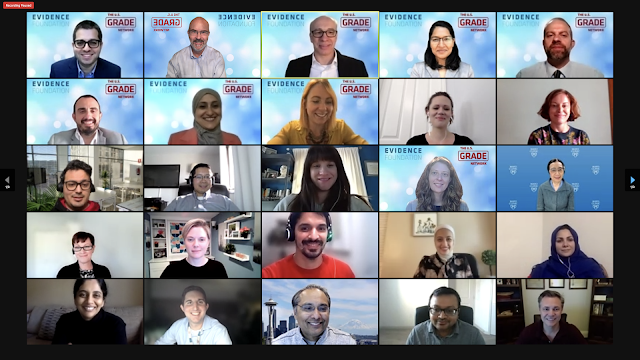
The USGN facilitators pose for a virtual group photo with the four fall 2020 Evidence Foundation scholars. Click to enlarge.

The Evidence Foundation thanks all four scholars for attending and contributing their engagement and expertise to our 2020 fall workshop.

If interested in applying for a scholarship to future GRADE workshops, more details can be found here: https://evidencefoundation.org/scholarships.html. Please note the deadline for applications to our next workshop in Chicago, Illinois will be February 28, 2021.




Monday, April 20, 2020

Spring 2020 - Scholarship Recipients

Earlier this month, the U.S. GRADE Network welcomed 51 participants to the Twelfth GRADE Guideline Workshop in sunny Phoenix, Arizona. Two participants, Giulia Lane and Hayley Dunnack, were awarded a scholarship from the Evidence Foundation that covered their workshop registration fee. As the two latest additions in a line of over 40 Foundation scholars since 2014, Lane and Dunnack presented to their fellow participants about their projects related to improving the use of evidence-based decision-making in healthcare.


Hayley Dunnack, left, and Giulia Lane, right, were the recipients of the Evidence Foundation scholarship for the spring 2020 GRADE workshop held in Phoenix, AZ

Hayley Dunnack: Opportunities and Challenges in Guidelines for Nursing Practice

Hayley Dunnack, BSN, CMS-RN, OCN is a PhD candidate at the University of Connecticut School of Nursing. Dunnack presented on her work with the Oncology Nursing Society (ONS) to develop guidelines on symptom management for patients with cancer. Currently, ONS has several projects underway to develop guidelines on symptom management based on systematic reviews of the evidence and using GRADE guideline methodology. A current challenge in the ONS’ guideline development relates to the development of guidelines on topics for which randomized studies are sparse or difficult to conduct, such as the management of hypersensitivity reactions or the use of vascular access devices.  Dunnack’s project aims to examine the use of non-randomized and “real-world” evidence to inform the development of rigorous guidelines based on systematic reviews and using the GRADE process.

“I had an incredible experience at the GRADE Guideline Development Workshop,” said Dunnack. “From the didactic material to the small group sessions, there was so much to learn. The ability to network with other professionals and hear their viewpoints added immensely to the experience."


Dunnack and Lane pose with Dr. Shahnaz Sultan of the U.S. GRADE Network

Giulia Lane: Shared Decision-Making in Urology Guidelines

Dr. Giulia Lane is a urology fellow at the University of Michigan. Lane’s project examines the current uptake and opportunities for improvement in the use of shared decision-making aids in the field of urology. Although shared decision-making aids are a critical step of assessing patients’ values and preferences, Lane explained, they are not commonly used in the field of urology. While almost everyone completes the initial step of informing patients about treatment options, exploring individual preferences is less frequent, and of the 29 American Urological Association (AUA) guidelines reviewed by Dr. Lane, only 12 mention shared decision-making at all. Of those guidelines that mentioned shared decision-making by name, only seven (58%) further described the process. Clinicians in urology, Dr. Lane concluded, are not provided support or encouragement to use shared decision-making in their practice. However, this appears to be changing: shared decision-making was mentioned in 2019 guidelines nearly eight times as often as those published in 2010.

In contrast to what is commonly believed, shared decision-making does not take more time once clinicians are trained. Clinicians should consider providing ready-made online modules to patients to review ahead of their visit, further reducing the time required to improve patient engagement and understanding of their treatment options. Dr. Lane’s work provides a baseline assessment of the use of shared decision-making in urology and will help inform the direction of future research in this area.

I felt that the best part of the GRADE workshop was the small-group setting with intimate access to experts in the field,” said Dr. Lane. “The networking opportunities were exceptional and I met several people with whom I plan to collaborate. The people I met at the GRADE workshop and the transfer of ideas were the most important take away point for me.”

If interested in applying for a scholarship to future GRADE workshops, more details can be found here: https://evidencefoundation.org/scholarships.html. Please note the deadline for applications to our next workshop in Chicago, Illinois will be July 31, 2020.

Tuesday, November 14, 2017

Join us in Cleveland, OH!

Our next Guideline Development Workshop using the GRADE approach will be held in Cleveland, OH from May 2nd through 4th, 2018. More information, including a proposed agenda, registration, and hotel information can be found at http://gradeconf.org/. As with every workshop, we encourage you to bring examples of your work and questions to discuss with participants at the workshop and the faculty.


We hope to see you there!

Tuesday, June 28, 2016

Scholarship Announcement for Next Guideline Development Workshop

Scholarship Opportunity Available for the Guideline Development Workshop

The U.S. GRADE Network in collaboration with Evidence Foundation is pleased to offer a scholarship program primarily for participants from North America for attendance of the Guideline Development Workshop in Orlando, FL. Recipients will be awarded a waived registration fee funded by the Evidence Foundation. The U.S. GRADE Network is now accepting applications (deadline: 8/31/2016).
Application: 500 words (or less) describing an innovation in guideline development, implementation, or teaching with the goal of reducing bias in health care recommendations. The innovation could be a future idea or proposal, or one that has already been implemented. The selected applicants will be given the opportunity to provide a 5-10 minute oral presentation to inform audience about their idea or project.
Candidates: New to GRADE without prior GRADE workshop attendance. Early involvement in guideline development (not based on age or experience). Access to a GRADE mentor following the workshop is a plus. The U.S. GRADE Network may be able to help identify a GRADE mentor.


Travel and lodging: Applicant’s institution pays for travel and lodging.


Application deadline: Please send application with a letter of support from your institution by August 31st, 2016 to US@gradeworkinggroup.org

Wednesday, January 27, 2016

Annoucement: Spring 2016 - Guideline Development Workshop

Calling all interested in learning about guideline development using the GRADE approach...
Our next Guideline Development Workshop featuring the GRADE Approach will be held April 20-22, 2016 in Kansas City, Missouri! Details about the workshop, including the schedule, tutors, and a link to register can be found at GRADEconf.org. Kansas City, Missouri (not to be confused with their neighbor Kansas City, Kansas), is known for having 200 fountains in the metropolitan area, only second to the number of fountains in Rome. In addition to beautiful architecture, Kansas City is now home to the 2015 World Series Champions! Go Royals! We look forward to seeing you in the great city of KC in April!