Monday, December 3, 2018

Research Shorts: Surrogate endpoints using the example of hepatitis C virus

Contributed by Claudia Dobler, MD, PhD
2018 U.S. GRADE Workshop Scholarship Recipient

Surrogate endpoints (for example laboratory or imaging results) are commonly used in clinical trials, as they require less participants and can be done in a shorter period of time compared to trials that use clinically important outcome measures such as mortality. When evidence for an intervention is almost exclusively based on trials that used surrogate outcomes, it is challenging for decision makers to determine the appropriateness of the use and reimbursement of an intervention. The common tendency in evidence-based medicine is to view results based on surrogate endpoints as less certain than results based on long term, final patient-important outcomes. The authors of this paper use the contemporary and highly debated example of the surrogate endpoint ‘sustained viral response’ (i.e., viral eradication considered to represent successful treatment) in patients treated for chronic hepatitis C virus infection to demonstrate how the validity of a surrogate endpoint can be critically appraised to assess the trustworthiness of the evidence and the implications for decision-making. They outline how the GRADE system for determining the certainty in the evidence can be used in situations where decisions for clinical practice and health policy have to be based on evidence that mainly comes from trials with indirect outcome measures.


Beyond assessing the quality of the evidence, potential benefits and harms of the intervention need to be weighed against each other and factors such as patient values, impact on healthcare equity, acceptability by patients and feasibility of the intervention need to be considered. The authors conclude that considering all these factors, a conditional recommendation for direct acting antiviral agents to treat chronic hepatitis C virus infection may be appropriate.


Reference: Dobler CC, Morgan RL, Falck-Ytter Y, Montori VM, Murad MH. Assessing the validity of surrogate endpoints in the context of a controversy about the measurement of effectiveness of hepatitis C virus treatment. BMJ evidence-based medicine 2018: 23(2): 50-53https://ebm.bmj.com/content/22/6/199

Monday, November 12, 2018

Research Shorts: Treatment Burden

Contribution from Claudia Dobler, MD, PhD
2018 U.S. GRADE Workshop Scholarship Recipient

Treatment burden is the work that patients need to do to implement treatments and its effect on patient functioning and well-being. The work that patients do to manage their health often remains invisible to health professionals, who might therefore overestimate patient’s capacity to take on more interventions. Treatment burden includes filling prescriptions, taking medications, attending medical appointments, monitoring their health, making lifestyle or behavioral changes, managing medical equipment or devices, and having to deal with insurance companies and the financial burden of health care. The evidence to decision framework developed by the GRADE Working Group addresses some parts of the construct of burden of treatment in the domains of acceptability and feasibility, but burden of treatment is currently not included as a discrete construct. The authors of this paper explore the idea of including information on treatment burden associated with interventions in clinical practice guidelines. Information on treatment burden would enable patients to make informed decisions about treatments. High-quality methods for assessing treatment burden need to be identified and meaningful ways of adding this information to clinical practice guidelines need to be explored. In the paper, practical examples are outlined of how treatment burden could be included in guidelines for chronic obstructive pulmonary disease, type 2 diabetes, and chronic kidney disease. Making treatment burden explicit for adhering to a special diet for chronic kidney disease, for example, could include information on foods that should be avoided, extra time spent on grocery shopping and cooking, challenges when eating out, the typical number of consultations with a dietitian, transport requirements to see a dietitian, time spent documenting the diet, and required intensity of blood tests to monitor electrolytes.


Clinicians should discuss values and preferences with patients, especially for treatments associated with a high workload. This would help clinicians to understand how individual patients prioritize different outcomes and treatment burden and would help patients to understand what components of their treatment are the essentials, even on a bad day, so that they can prioritize treatments appropriately.


Dobler CC, Harb N, Maguire CA, Armour CL, Coleman C, Murad MH. Treatment burden should be included in clinical practice guidelines. BMJ 2018: 363. https://www.bmj.com/content/363/bmj.k4065

Tuesday, June 5, 2018

Drug Value Symposium

The first Drug Value Symposium was held in Cleveland, Ohio on May 5th, 2018 in conjunction with the 8th Guideline Development Workshop using the GRADE approach.

Attendees found the inaugural Drug Value Symposium to be engaging, appreciating the opportunity to share ideas on how to systematically approach making evidence-based drug-coverage decisions at their institutions.

Attendees from all over the world with various backgrounds and expertise attended. The symposium opened with a thought-provoking presentation from Yngve Falck-Ytter, one of the founding U.S. GRADE Network members. His presentation highlighted why healthcare costs are becoming an increasing challenge and how incorporating a methodologically rigorous framework, such as GRADE, to formulary decision making can facilitate sensible decisions. 

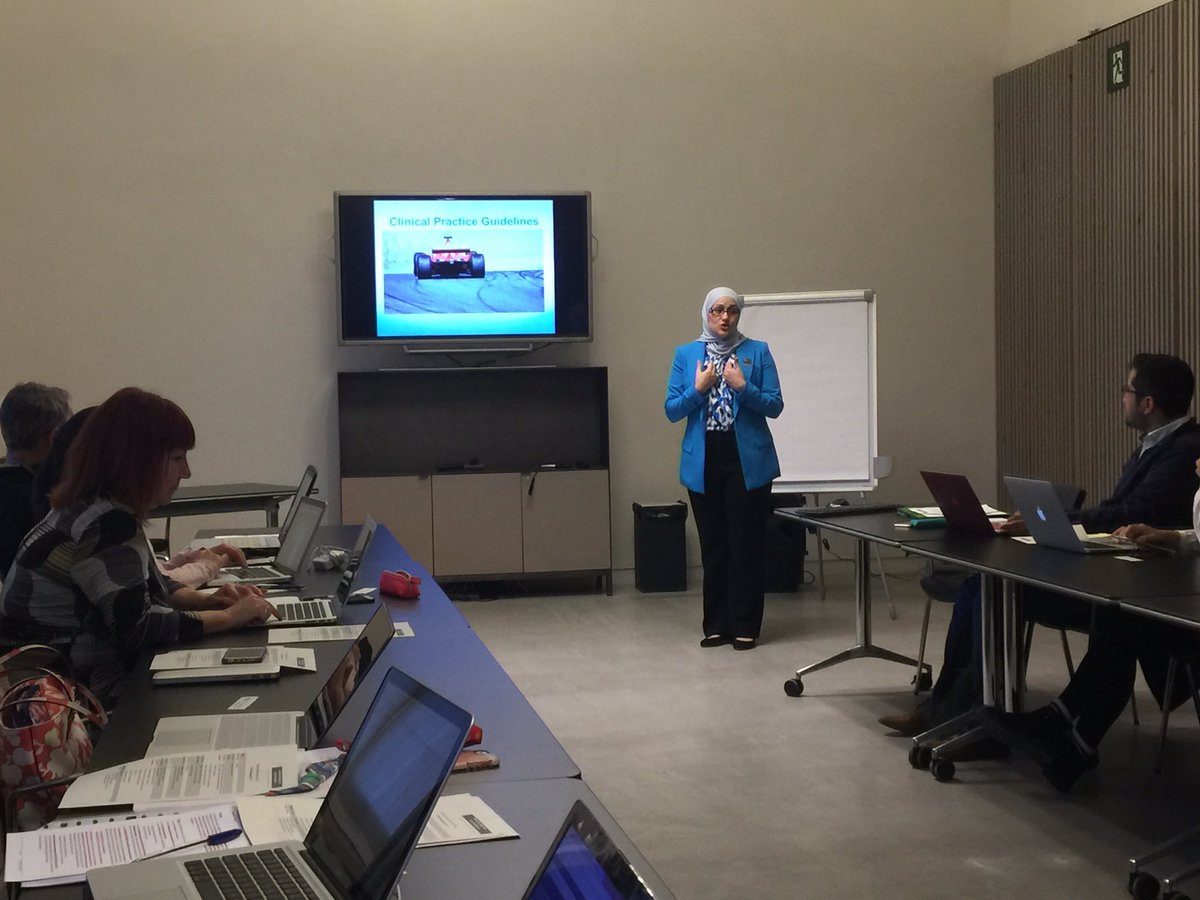
Dr. Falck-Ytter opens the symposium with an overview of how GRADE includes both cost and cost-effectiveness when making health-care decisions.

Representatives from local healthcare systems then offered varying perspectives on the institutional successes and challenges of managing high cost drugs. Presenters included Mandy Leonard from Cleveland Clinic, Indrani Kar from University Hospitals, Christina Wadsworth and Jan Kover from MetroHealth, and Candice Wenzell from the Northeast Ohio VA Healthcare System. 

       Lessons learned from managing costly drugs within the Cleveland, OH 
Veteran's Administration, as presented by Ms. Wenzell.

The symposium concluded with an interactive session facilitated by Yngve Falck-Ytter, Candice Wenzell, and Kelsey Rife that allowed attendees to apply the GRADE methodology to evaluate a drug for a specific indication and then make a decision on whether or not they would recommend the use of the drug. 

Tuesday, November 14, 2017

Join us in Cleveland, OH!

Our next Guideline Development Workshop using the GRADE approach will be held in Cleveland, OH from May 2nd through 4th, 2018. More information, including a proposed agenda, registration, and hotel information can be found at http://gradeconf.org/. As with every workshop, we encourage you to bring examples of your work and questions to discuss with participants at the workshop and the faculty.


We hope to see you there!

It's been a DTA kind of year

We started 2016 in Minneapolis by hosting our regular Guideline Development Workshop focused on making recommendations about diagnostic tests and test strategies. In 2016, the GRADE Working Group released guidance on decision making about diagnostic tests. That paper can be found here. Our Spring workshop featured three days of guideline development materials tailored for tests and test strategies, including a pre-course systematic review workshop on how to meta-analyzing this material. Dr. Holger Schünemann provided guest lectures and support during the small group exercises.


Earlier this week, in collaboration with the Dutch GRADE Network and Barcelona GRADE Center, Dr. Reem Mustafa kicked off a similar workshop on diagnostic test accuracy (DTA).


Many resources have been released detailing the advancements in DTA decision making. A few are listed below:

Thursday, June 30, 2016

Proposed new evidence-based medicine pyramid


Systematic reviews and meta-analyses have been placed at the top of the evidence pyramid for several good reasons. They provide more trustworthy answers and more precise estimates with narrower confidence intervals that are were not selected based on expert opinion, but rather based on a systematic procedure. However, credible systematic review can summarize biased evidence and poorly done systematic reviews can summarize well done trials. This challenges the placement on top. In addition, GRADE tells us that our certainty in evidence should be driven by many factors other than study design. Therefore, we propose 2 modifications to the pyramid to resolve these 2 challenges.

Figure 1.

Legend: The proposed new evidence-based medicine pyramid. (A) The traditional pyramid. (B) Revising the pyramid: (1) lines separating the study designs become wavy (Grading of Recommendations Assessment, Development and Evaluation), (2) systematic reviews are ‘chopped off’ the pyramid. (C) The revised pyramid: systematic reviews are a lens through which evidence is viewed (and applied).

Tuesday, June 28, 2016

Scholarship Announcement for Next Guideline Development Workshop

Scholarship Opportunity Available for the Guideline Development Workshop

The U.S. GRADE Network in collaboration with Evidence Foundation is pleased to offer a scholarship program primarily for participants from North America for attendance of the Guideline Development Workshop in Orlando, FL. Recipients will be awarded a waived registration fee funded by the Evidence Foundation. The U.S. GRADE Network is now accepting applications (deadline: 8/31/2016).
Application: 500 words (or less) describing an innovation in guideline development, implementation, or teaching with the goal of reducing bias in health care recommendations. The innovation could be a future idea or proposal, or one that has already been implemented. The selected applicants will be given the opportunity to provide a 5-10 minute oral presentation to inform audience about their idea or project.
Candidates: New to GRADE without prior GRADE workshop attendance. Early involvement in guideline development (not based on age or experience). Access to a GRADE mentor following the workshop is a plus. The U.S. GRADE Network may be able to help identify a GRADE mentor.


Travel and lodging: Applicant’s institution pays for travel and lodging.


Application deadline: Please send application with a letter of support from your institution by August 31st, 2016 to US@gradeworkinggroup.org